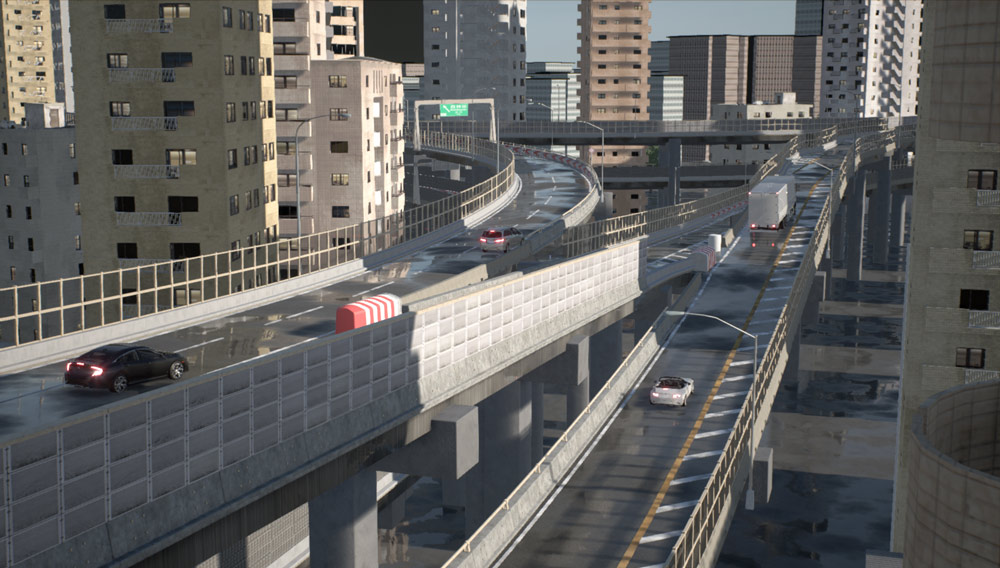
Build technology that lets AVs see

Perception systems allow autonomous vehicles (AVs) to see the world around them and make decisions about the safest course of action in every encountered situation. Applied’s sensor simulation team builds technology that accelerates the development of perception systems for the world’s leading autonomy programs.
Our Technology
Synthetic sensor data for perception development
Perception systems are safety critical but are difficult to develop because of their impact on the rest of the AV stack, the complexity of on-road testing, and a near infinite number of scenarios that an autonomous vehicle could encounter in the real world.

Many of the world’s most advanced autonomy programs use Spectral to generate synthetic sensor data, which enables them to reliably train, test, and validate their perception systems in any scenario or environment of interest.
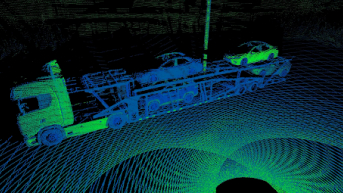
Validated sensor models
Validated models of the cutting-edge sensors enable Spectral to generate high-fidelity synthetic camera, lidar, and radar data.
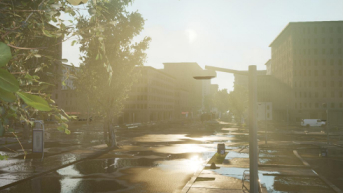
Diverse 3D environments
Procedurally generated 3D environments empower teams to generate synthetic data that directly matches their operational design domain (ODD).
Automatic annotations
Programmatically generated ground truth labels facilitate model training and evaluation without the hassle or error associated with manually generated labels.

Software and functional experts
Meet our team
Click through the buttons to meet our interdisciplinary team that combines experience from automotive, semiconductor, gaming, and traditional software industries.
Front-End Engineer
Sensor Simulation Expert
Procedural Artist
Environment Artist
Mike
Front-End Engineer
Previously Facebook, Famous.co
“Our UI-based tools require cutting-edge technologies to visualize simulations in a performant, accurate manner. We're continuously adding new features to improve the visualization and robustness of our tools to support diverse, complex use cases for our autonomy products.”
What do Front-End Engineers do?
Build tools that empower customers to create and visualize simulations, bridging the gap between Spectral’s complex 3D world and our web-based front-end.
What's unique about this role?
Own front-end development for Spectral end-to-end, with initial projects in environment creation, sensor configuration, and scenario editing
Leverage a love of product design, fluid interfaces, and 3D graphics to build tools that enable safe and rapid development of autonomous systems
Become an expert in simulation and autonomy
Collaborate directly with customers to understand and advocate their needs throughout product design and development
Day in the life of a Front-End Engineer
10:00 AM
Work with design and product to understand the goals for a new sensor configuration tool and why customers are excited about it. Consult on technical feasibility of features.
11:00 AM
Engineering design. Collaborate with teammates working on our rendering engine, sensor models, and cloud infrastructure to understand the optimal implementation path.
12:30 PM
Midday break to attend a UX design class covered by the company education stipend.
1:30 PM
Begin implementation and review prototypes with reference customers.
3:45 PM
Pick kids up from school and go to the park!
7:45 PM
Finish up work after kids go to bed.
Alex
Sensor Simulation Expert
Previously Analog Devices, University of Illinois at Urbana-Champaign
“Sensor simulation is right at the intersection of sensor systems, autonomy perception development, and computational techniques. This gives the opportunity to not only learn how each sensor operates, but also how they're used in the downstream systems that are driving the advancement in hardware technologies.”
What do Sensor Simulation Experts do?
Research and develop cutting edge sensor simulation approaches for the latest hardware. Empower customers to rapidly adopt new hardware and safely develop autonomous perception systems.
What's unique about this role?
Rapidly iterate in software to bring models to customers in weeks as opposed to years
Develop expertise in multiple sensing modalities and form an end-to-end understanding of each sensor
Collaborate with sensor vendors and customers to learn about industry trends
Build tools that enable safe and rapid development of autonomous systems across the entire AV industry
Day in the life of a Sensor Simulation Expert
9:00 AM
Finish up work on a polarimetric radar model.
10:00 AM
Meet with a customer perception team to learn about the lidar-based object detection module they want to simulate.
11:00 AM
Model the customer’s lidar hardware using public datasheets. Realize that higher-fidelity modeling is required given differences in the scan pattern.
2:00 PM
Contact the sensor vendor to learn about their new scan pattern and obtain sample data and hardware to validate the model.
3:00 PM
Company ping pong tournament!
4:30 PM
Dig into the sample data to understand new phenomena that need to be added to Spectral’s lidar model. Research the phenomena and begin implementation by validating against the sample data and hardware as needed.
Freek
Procedural Artist
Previously Apple, Electronic Arts
“We get to work on the biggest, most purely procedural generation problem ever — building the planet. Our clients require photo-realistic recreations of complex environments on short timelines (hours or days, as opposed to years). It's extremely challenging, but also very satisfying.”
What do Procedural Artists do?
Develop procedural pipelines used to generate diverse and realistic 3D environments. Environments span a diverse range of domains, from dense urban environments to warehouses and railroads.
What's unique about this role?
Collaborate with customers to understand their operating design domain (ODD) and create representative environments
Dig into new environments and challenges as Spectral continues to expand into new verticals
Leverage Houdini to build procedural environment pipelines
Optimize the realism of 3D environments such that synthetic data accurately represents the analogous real-world data
Day in the life of a Procedural Artist
9:00 AM
Finish up working on a procedurally generated warehouse environment.
10:00 AM
Meet with a customer perception team to learn about a new railroad environment they want to simulate.
11:00 AM
Study the railroad and understand the patterns that dictate how the tracks are structured.
12:00 PM
Midday break to attend digital art class covered by company education stipend.
2:00 PM
Work in Houdini to build a procedural pipeline that accurately generates rail environments representing those the customer operates in. Ensure that rails connect and that assets, such as the gates at rail crossings, are placed accurately.
4:00 PM
Collaborate with environment artists to identify and scope new assets that must be created to populate the rail environment.
Jansen
Environment Artist
Previously Humber College, Vertex School
"Being an environment artist at Applied means pushing yourself everyday to find ways to effectively recreate regions and scenarios from the real world. Our work heavily leverages proceduralism, which makes it possible to approach these challenges in unique ways and quickly produce tangible results."
What do Environment Artists do?
Build assets to populate the varied environments that our customers simulate, ranging from dense cities to agricultural fields and warehouses. Utilize procedural textures to increase asset diversity and prevent overfitting.
What's unique about this role?
Optimize assets for training and testing machine learning systems
Leverage proceduralism to create diverse content that prevents model overfitting
Work with technical artists to intelligently designs kits that enable the creation of diverse and performant large-scale environments
Create flexible and complex material systems to enable accurate simulation of things such as retroreflectivity, paint chipping, and weather
Day in the life of an Environmental Artist
9:00 AM
Meet with a customer perception team to learn about the section of Tokyo they want to simulate and the objects that their AV stack needs to recognize.
10:00 AM
Comb through Tokyo using Google Street View to understand how the neighborhoods are structured and take note of interesting assets.
12:00 PM
Monthly “Lunch & Learn."
1:00 PM
Work with technical artists to discuss logical ways to break down assets and any new materials that must be implemented.
2:00 PM
Get to work modeling assets!
4:00 PM
Foosball break with coworkers.
4:15 PM
Continue modeling assets.
Apply today